This thesis explores the tension between two inherited value systems: one grounded in domestic memory, care, and the slow continuity of keeping; and another defined by measurement, achievement, and the performance of success. Growing up, I learned that wealth could mean two opposite things at once; an object repaired and kept, or a number earned and displayed.
Through writing, material experimentation, and personal artifact analysis, I examine how these contradictory definitions shaped my understanding of belonging and worth. By reframing stains, threads, uniforms, and everyday objects as sites of meaning rather than shame, I practice unlearning as a form of design. Ultimately, this thesis asks how we might build value systems that honor what sustains us rather than what can be counted, and how we might redefine success as something we keep alive, not something we climb toward.
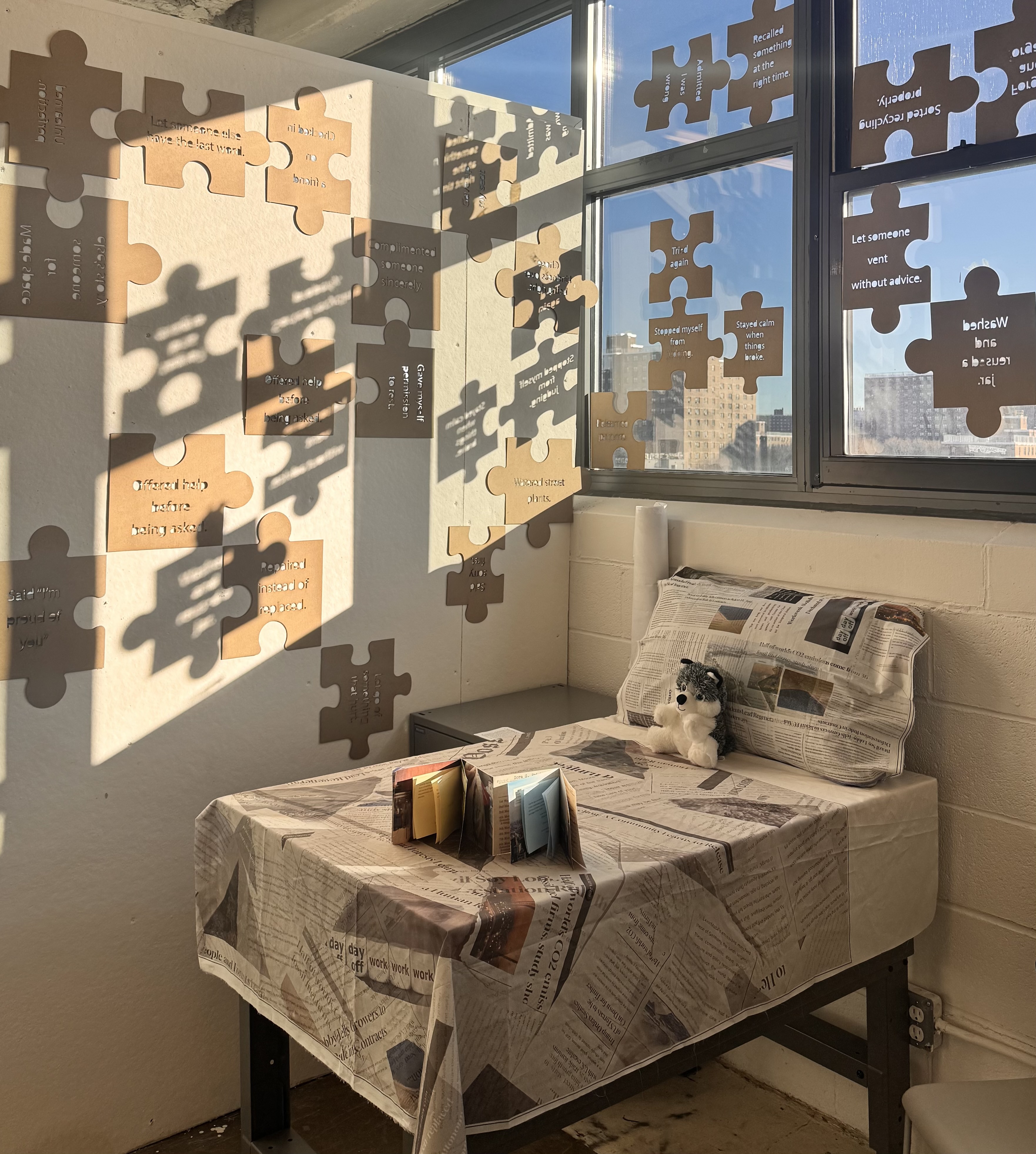
The installation reconstructs my childhood bedroom as a space where ideas of value, care, and belonging were first shaped, and where they can now be reinterpreted. My childhood bedroom is, I believe, the earliest site of identity formation. It is where private routines, emotions, and unspoken forms of labor quietly accumulated. This bedroom is where many of the grounding thoughts and values I still hold were formed. By restaging this space, I created a setting to examine and unmake those inherited ideas.
The bedroom functions as a bridge between two worlds: the rewritten public stories on the bed and the unrecognized private stories on the walls. It holds both the narratives imposed on me and the ways those narratives shaped my core values. The bedroom allowed the project to move away from spectacle and toward intimacy. It created a slow, reflective environment where value is not measured through achievement or output, but through continuity, care, and the small gestures that form a life.
This shift reflects a broader change in my design thinking. Rather than using design to illustrate an argument, I began using it to construct conditions for reflection. Materials became conceptual tools: chipboard as hidden structure, fabric as vulnerability, fragmentation as resistance to fixed meaning. Each transformation, from writing to object to environment, revealed how conformity, care, and belonging operate not only as systems, but as lived experiences.
Through evaluating this process, I now understand my work less as a collection of artifacts and more as an evolving system of translations between text, material, and space. This project has taught me that making can be a form of thinking, and that design can operate as a method of unlearning—one that allows inherited definitions of value to be held, questioned, and reshaped rather than simply rejected.